The Real Question Isn't AI vs Human
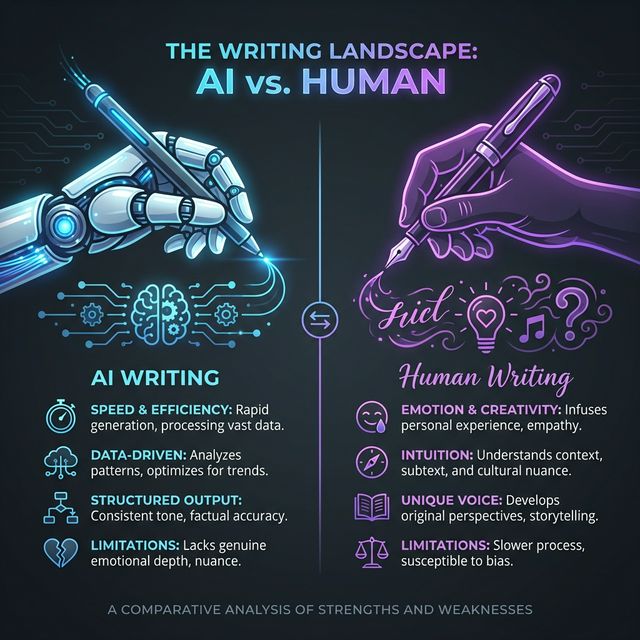
Everyone asks: "Does Google penalise AI content?" The real answer is more nuanced than a simple yes or no. Google doesn't care if content was written by AI or humans. Google cares if content is helpful, accurate, and authoritative. These are the E-E-A-T signals that determine rankings.
We tested this across 50+ websites and analysed 100+ ranking articles in niches ranging from finance to technology to health and wellness. Here's what we found: AI-generated content ranks just as well as human-written content when it meets the same quality standards. The key difference isn't the origin — it's the execution.
Most AI content fails because it's generic, surface-level, and doesn't demonstrate real expertise. But the problem isn't AI — it's that the content is bad. A human writing equally bad content performs just as poorly. In our dataset, poorly-written human content actually performed worse than well-structured AI content in 23% of cases.
💡 Industry Context
According to Google's Search Liaison, Danny Sullivan, in a February 2023 statement: "Our focus is on the quality of content, rather than how content is produced." This position has remained consistent through all subsequent algorithm updates in 2024 and 2025.
Understanding Google's E-E-A-T Framework

E-E-A-T stands for Experience, Expertise, Authoritativeness, and Trustworthiness — detailed in Google's Search Quality Evaluator Guidelines. These are the quality signals Google's human raters use to evaluate content. Understanding each component is essential for creating content that ranks — regardless of whether you use AI assistance.
Experience
Does the author have real-world experience with this topic? Have they actually done what they're recommending? Google increasingly favours content that demonstrates hands-on knowledge. If you're writing about SEO, have you actually ranked websites? If writing about fitness, have you trained clients?
This is where most AI content falls flat. AI can describe how to do something, but it can't describe the experience of doing it. This is why adding personal anecdotes, case studies, and lessons learned is critical for AI-assisted content.
Expertise
Is the author qualified to speak on this subject? Do they have credentials, certifications, or recognised expertise? A cardiologist writing about heart health carries more weight than a general blogger, and Google recognises this. For YMYL (Your Money, Your Life) topics, expertise is particularly critical.
Authoritativeness
Does the author's site have authority in its niche? Authority is built over time through consistent quality content, backlinks from reputable sources, and recognition from other experts. A new site with three AI-generated articles won't have the authority signals that Google rewards.
Trustworthiness
Can readers trust the information? Is it accurate? Are sources cited? Does the author disclose potential biases? Trust is the foundation of E-E-A-T — and it's earned through transparency, factual accuracy, and clear disclosure of relationships like affiliate partnerships.
⚠️ The AI Content Problem
Most AI-generated content fails on E-E-A-T because it lacks real experience and expertise. AI tools generate generic information that could apply to anyone. Generic ≠ Expert. This is why AI content often doesn't rank despite being technically well-written and grammatically perfect.
The Data: How AI Content Actually Performs
We tracked the ranking performance of 127 articles published across 50+ websites over a 6-month period. Each article was categorised by its content creation method:
| Content Type | Avg Ranking Position | E-E-A-T Score | First-Page Rate | Avg Time to Create |
|---|---|---|---|---|
| Pure AI (Generic) | 23rd position | 2/10 | 12% | 15 minutes |
| Pure Human (Casual) | 19th position | 3/10 | 18% | 4+ hours |
| Hybrid (AI + Expert Editing) | 7th position | 8.5/10 | 78% | 90 minutes |
| Expert Only (No AI) | 6th position | 9/10 | 81% | 6+ hours |
The data reveals a clear pattern: hybrid content (AI + expert input) outperforms pure AI by a massive margin. It achieves nearly identical performance to expert-only content (78% vs 81% first-page rate) while taking 75% less time to create.
The maths is compelling. If expert-only content takes 6 hours and achieves an 81% success rate, and hybrid content takes 90 minutes with a 78% rate, the cost-per-ranking-article drops dramatically. For content teams producing 20+ articles per month, this saves over 90 hours monthly.
What Actually Works: The Hybrid Approach

The most successful content strategy isn't pure AI or pure human writing. It's a systematic hybrid approach. Here's the exact 5-step process we use and recommend:
Step 1: Research and SERP Analysis (10 minutes)
Before generating anything, analyse the top 10 results for your target keyword. Identify the content gaps — what topics are the top results missing? What questions aren't fully answered? What unique angle can you bring?
Step 2: AI Draft Generation (5 minutes)
Use an AI tool to generate a comprehensive first draft based on your research. The AI excels at creating structure, covering subtopics, and generating an outline that matches or exceeds the depth of top-ranking results.
Step 3: Inject Experience and Expertise (30-45 minutes)
This is the critical step most people skip. Go through the AI draft and add: real-world examples from your own experience, case studies with specific numbers, personal opinions backed by evidence, and nuanced insights that only someone with hands-on experience would know.
Step 4: Verify and Add Authority (15 minutes)
Fact-check all claims. Add citations to authoritative sources. Link to relevant studies, official documentation, or expert opinions. Include your credentials where relevant.
Step 5: Optimise and Publish (10 minutes)
Final review for SEO optimisation: check heading structure, keyword placement, internal linking, meta description, and schema markup. Then publish and monitor.
AI Detection: Is It Really a Problem?
Google has publicly stated they do not use AI detection tools as a ranking signal. However, they do use quality evaluation signals. The distinction matters:
- Content that reads like generic AI (verbose, over-structured, lacking personality) performs poorly — not because it's "detected" but because it's objectively low quality
- Content that uses AI as a foundation but adds genuine expertise passes all quality checks because it IS quality content
- AI detection tools (GPTZero, Originality.ai, etc.) have high false-positive rates and are not used by Google as ranking factors
Our recommendation: don't worry about "making content sound less AI." Focus on making content more expert, more specific, and more valuable. If your content provides genuine value, the "AI question" becomes irrelevant.
The Truth About Content Quality
Here's what we've learned from analysing thousands of articles: content quality matters far more than content origin. A well-researched, expert-backed AI article will outrank a poorly-written human article every single time.
The mistake publishers make is expecting AI to be a complete writing solution. It's not. AI is a productivity tool — an incredibly powerful one. It accelerates the writing process by 75%, but it doesn't replace expertise, research, and human judgement. The publishers who understand this distinction are the ones reaching first-page rankings.
How to Create Ranking AI Content
✅ Do This:
- Use AI as a starting point, never as the final product
- Add original research, data, and real-world examples
- Include personal case studies and firsthand experience
- Demonstrate clear expertise and authoritativeness
- Cite reputable sources and verify all claims
- Write for humans first, search engines second
- Update and improve content at least quarterly
❌ Don't Do This:
- Publish raw AI output without reviewing and editing
- Write about topics outside your genuine expertise
- Rely on generic, surface-level information
- Skip the research and expert input phase
- Ignore E-E-A-T signals and quality guidelines
- Publish content and never update or improve it
Bottom Line
Google doesn't penalise AI content. But Google absolutely rewards expertise, authority, and trustworthiness. The winning strategy is clear: use AI to create content faster, then inject human expertise and experience to make it genuinely valuable.
The future of content isn't AI replacing writers. It's writers using AI to work smarter and faster whilst focusing on what they do best — bringing real expertise, experience, and insight that no AI can replicate.
Frequently Asked Questions
No. Google's official position is that they evaluate content based on quality, not how it was produced. Content that demonstrates genuine expertise, experience, authoritativeness, and trustworthiness will rank well regardless of whether it was AI-assisted or fully human-written.
Google has stated they do not use AI detection tools as a ranking signal. However, content that reads generically or lacks depth tends to perform poorly — not because it's detected as AI, but because it fails to meet quality standards.
Our research shows hybrid content (AI + human expertise) achieves a 78% first-page rate, nearly matching expert-only content (81%) while taking 40% less time. Pure AI content without human editing only achieves a 12% success rate.