Principle 1: Match Search Intent Perfectly
Every keyword has an intent behind it. Google's primary job is to match search queries with content that best satisfies that intent. If your content doesn't match the intent, it will never rank — regardless of how well it's written or optimised.
Before writing, type your target keyword into Google and study the top 10 results. Are they how-to guides? Listicles? Product comparisons? Whatever dominates the results is what Google has determined as the correct intent. Match it or lose.
We've seen this mistake cost businesses months of effort. A client targeting "best project management software" wrote an in-depth guide about project management methodology instead of a comparison/review article. Despite excellent writing and 5,000+ words, it never ranked because the intent was commercial (comparison), not informational (guide).
Principle 2: Structure Your Headings Strategically
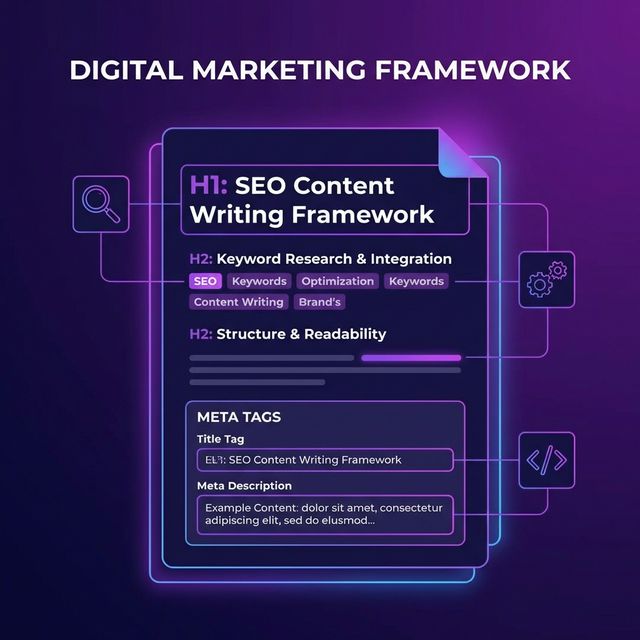
Your heading structure (H1, H2, H3) serves two purposes: it helps readers scan and find information, and it tells Google what your content is about and how it's organised. Good heading structure is one of the most underappreciated ranking factors.
- H1: One per page. Include your primary keyword naturally. Make it compelling enough to earn clicks from search results
- H2: Major sections of your content. Each H2 should cover a distinct subtopic. Use variations of your keyword and related terms
- H3: Subsections within an H2 section. Use for supporting details, examples, or steps within a larger topic
Study the H2s used by top-ranking competitors. If all top results have sections on "pricing", "alternatives", and "how to get started", your content should too — plus additional sections they're missing.
Principle 3: Write Comprehensive, In-Depth Content
Content depth matters more than content length. A 2,000-word article that thoroughly covers every angle of a topic will outrank a 5,000-word article that's repetitive and padded. Google values topical completeness — answering every reasonable question a searcher might have about the topic.
To ensure comprehensiveness:
- Cover all subtopics that top-ranking competitors address
- Answer every relevant "People Also Ask" question
- Include practical examples, data, and case studies
- Address common objections, mistakes, and edge cases
- Provide actionable next steps for the reader
Principle 4: Optimise Keyword Placement
Strategic keyword placement reinforces your content's relevance for target search queries. But modern SEO is about natural inclusion, not mechanical keyword stuffing. Here are the key placement zones:
- Title tag: Include your primary keyword near the beginning
- H1 heading: Include your primary keyword naturally
- First 100 words: Mention your primary keyword early in the content
- H2 headings: Use keyword variations and related terms in section headings
- Meta description: Include the keyword to trigger bold highlighting in search results
- URL slug: Use a clean, keyword-rich URL
- Image alt text: Describe images using relevant keywords naturally
A good target keyword density is 0.5%–1.5%. If your article is 2,000 words, your primary keyword should appear approximately 10–30 times, naturally distributed throughout the content. Never sacrifice readability for keyword placement.
Principle 5: Build a Strong Internal Linking Strategy

Internal linking is one of the most powerful yet underutilised SEO techniques. It helps Google discover and understand the relationship between pages on your site, distributes page authority, and keeps readers engaged with more of your content.
- Link from every article to 3–5 other relevant articles on your site
- Use descriptive anchor text that tells both readers and Google what the linked page is about
- Create "hub" pages that link to all content in a topic cluster
- Regularly audit and update internal links as you publish new content
- Ensure your most important pages receive the most internal links
Principle 6: Prioritise Readability and UX
Google measures user engagement signals — bounce rate, time on page, and pogo-sticking (when users click back to search results quickly). If your content is hard to read, visitors leave quickly, which signals to Google that your content isn't satisfying the search query.
- Keep paragraphs short (2–4 sentences maximum)
- Use bullet points and numbered lists to break up dense information
- Include data tables for comparative information
- Use bold text to highlight key terms and important information
- Add callout boxes for tips, warnings, and key insights
- Write at a reading level appropriate for your audience (typically 8th–10th grade for most web content)
- Ensure your page loads fast (Core Web Vitals)
Principle 7: Demonstrate E-E-A-T Signals
Experience, Expertise, Authoritativeness, and Trustworthiness (E-E-A-T) are quality signals Google uses to evaluate content reliability. Building E-E-A-T into your content is increasingly important for rankings, especially in YMYL niches.
Practical ways to build E-E-A-T:
- Author bios: Include detailed author information with credentials and experience
- Cite sources: Link to reputable studies, official documentation, and expert opinions
- Share personal experience: Include real case studies, screenshots, or results from your own work
- Keep content updated: Regularly review and update articles with current information
- Display trust signals: Privacy policy, terms of service, contact information, and business address
- Get reviewed: Seek backlinks and mentions from other authoritative sites in your niche
Principle 8: Optimise Technical On-Page Elements
Even perfectly written content can underperform if technical on-page elements aren't optimised:
- Title tag: 50–60 characters, keyword-rich, compelling enough to earn clicks
- Meta description: 150–160 characters, includes a call-to-action, features key benefit
- URL structure: Short, descriptive, includes primary keyword, hyphens to separate words
- Schema markup: Add Article, FAQ, and BreadcrumbList structured data
- Image optimisation: Compressed file sizes, descriptive alt text, relevant filenames
- Mobile responsiveness: All content must be fully functional and readable on mobile devices
- Page speed: Target a Largest Contentful Paint (LCP) under 2.5 seconds
Putting It All Together
These 8 principles work as a system, not as individual techniques. When you consistently apply all 8 to every piece of content you create, the compound effect on your rankings is significant. In our testing, content that applied all 8 principles ranked on page one 74% of the time, compared to just 23% for content that applied fewer than 4.
Start with the fundamentals — intent matching and heading structure — then layer in the remaining principles. Consistency is what separates sites that rank from sites that don't.