🔴 Critical Impact (Factors 1–8)
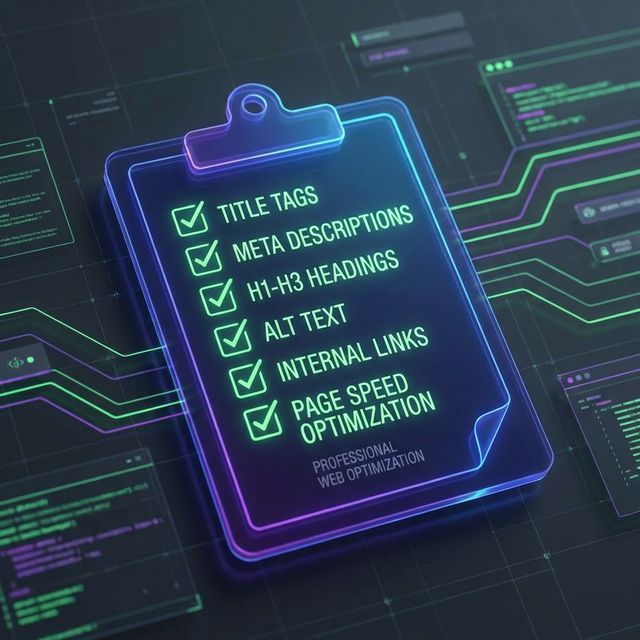
These factors have the highest measurable impact on rankings. Getting any of these wrong can prevent even excellent content from ranking.
1. Title Tag Optimisation
Your title tag is the single most important on-page element. It appears as the clickable headline in search results and is Google's primary signal for understanding page content.
- Include your primary keyword near the beginning
- Keep it under 60 characters to avoid truncation
- Make it compelling — your title competes for clicks against 9 other results
- Use power words: "Complete", "Ultimate", "Guide", "2026"
- Each page must have a unique title tag
2. Search Intent Alignment
Your content must match what searchers are looking for. If the top 10 results for your keyword are all how-to guides, don't publish a product page. Match the format, depth, and angle that Google has already determined is correct.
3. Content Comprehensiveness
Google rewards content that thoroughly covers a topic. Analyse the top-ranking pages for your keyword and ensure your content covers all the subtopics they address, plus additional angles they miss. Depth, not length, is what matters.
4. Heading Structure (H1–H6)
Proper heading hierarchy serves both users (scanability) and search engines (content understanding):
- One H1 per page containing your primary keyword
- H2s for major sections — include keyword variations
- H3s for subsections within H2 sections
- Never skip heading levels (e.g., H1 → H3)
5. URL Structure
Clean, descriptive URLs improve both user experience and search engine understanding:
- ✅ Good:
/on-page-seo-checklist - ❌ Bad:
/p?id=847&cat=3 - Keep URLs short (3–5 words ideally)
- Use hyphens to separate words
- Include your primary keyword
6. Meta Description
While not a direct ranking factor, meta descriptions significantly impact click-through rate (CTR), which IS a ranking signal:
- Write 150–160 characters
- Include your primary keyword (it gets bolded in results)
- Add a clear call-to-action or benefit statement
- Each page needs a unique meta description
7. Internal Linking
Internal links distribute authority, help Google discover pages, and keep users engaged:
- Link to 3–5 related pages from every article
- Use descriptive anchor text (not "click here")
- Link from high-authority pages to newer pages
- Create topic clusters with hub pages
8. Mobile Responsiveness
Google uses mobile-first indexing — your mobile site IS your site. Ensure all content, images, and functionality work perfectly on mobile devices. Test with Google's Mobile-Friendly Test tool.
🟠 High Impact (Factors 9–16)
9. Page Speed (Core Web Vitals)
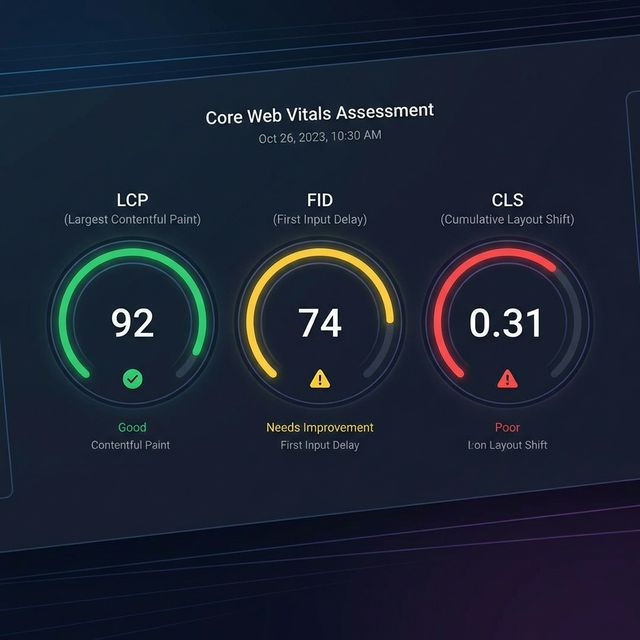
Google's Core Web Vitals are confirmed ranking factors. Target these thresholds:
| Metric | Good | Needs Improvement | Poor |
|---|---|---|---|
| LCP (Largest Contentful Paint) | ≤ 2.5s | 2.5–4.0s | > 4.0s |
| FID (First Input Delay) | ≤ 100ms | 100–300ms | > 300ms |
| CLS (Cumulative Layout Shift) | ≤ 0.1 | 0.1–0.25 | > 0.25 |
10. Keyword Placement
Strategic keyword placement reinforces relevance. Include your primary keyword in: the first 100 words, at least 2 H2 headings, image alt text, and naturally throughout the body. Target 0.5–1.5% keyword density.
11. Image Optimisation
Images improve user engagement and provide additional ranking opportunities:
- Use descriptive, keyword-rich file names
- Write meaningful alt text for every image
- Compress images (target under 100KB per image)
- Use modern formats (WebP) when possible
- Specify width and height to prevent layout shifts
12. E-E-A-T Signals
Demonstrate Experience, Expertise, Authoritativeness, and Trustworthiness through author bios, citations, credentials, and factual accuracy.
13. Content Freshness
For time-sensitive topics, content freshness is a ranking factor. Include publication and update dates. Review and update content at least quarterly.
14. External Linking
Link to authoritative, relevant sources. This demonstrates research and builds trust. Use 3–5 external links per article to reputable sources.
15. Schema Markup (Structured Data)
Schema markup helps Google understand your content and can generate rich snippets in search results. Key types include Article, FAQ, HowTo, BreadcrumbList, and Organisation schema.
16. Canonical Tags
Prevent duplicate content issues by specifying the canonical URL for each page. This tells Google which version of a page to index and rank.
🟡 Moderate Impact (Factors 17–25)
17. Open Graph Tags
While not direct ranking factors, OG tags control how your content appears when shared on social media, improving CTR and visibility.
18. Content Readability
Write at an 8th–10th grade reading level for general audiences. Use short paragraphs (2–4 sentences), bullet points, and bold text for key terms.
19. HTTPS Security
HTTPS is a confirmed ranking signal. Ensure your entire site is served over HTTPS with a valid SSL certificate.
20. Breadcrumb Navigation
Breadcrumbs improve user navigation and appear in search results. Use BreadcrumbList schema to enhance their appearance.
21. Table of Contents
For long-form content, a linked table of contents improves user experience and can generate sitelinks in search results.
22. Content Format Diversity
Mix text with tables, lists, callout boxes, and embedded media. Diverse content formats improve engagement signals and time on page.
23. Social Sharing Buttons
While social signals aren't direct ranking factors, making content easy to share can generate backlinks and brand mentions that do impact rankings.
24. Robots Meta Tags
Use robots meta tags to control how search engines crawl and index each page. Ensure important pages are set to "index, follow".
25. Sitemap Inclusion
Include all important pages in your XML sitemap and submit it through Google Search Console. This ensures Google discovers and indexes your content efficiently.
Implementation Priority
Don't try to optimise all 25 factors simultaneously. Focus on the critical factors (1–8) first — these deliver 80% of the on-page SEO impact. Once those are solid, layer in the high-impact factors (9–16), then the moderate ones (17–25).
For existing content, audit your top 10 pages against this checklist. Fixing critical gaps on existing pages often delivers faster ranking improvements than creating new content.